
Understanding the “Heavy Head” Phenomenon: Why Your Office Job is Starving Your Neck Muscles (and How to Fix It)



upper shoulder and neck pain
Heavy Head Phenomenon, your Office Job, and fixing it yourself
We have all been there. It is 3:00 PM on a busy workday, you are typing away to meet a deadline, and you suddenly notice a dull, radiating ache creeping up the back of your neck. You try to shrug your shoulders, roll your head around, or rub the tight knots near your skull, but the relief only lasts for a few fleeting minutes.
If you work a desk job, exercise regularly, eat well, and still struggle with persistent neck stiffness, you might be wondering why your body refuses to let go of this tension.
The secret doesn’t lie in a lack of stretching or a bad gym routine. Instead, it comes down to a silent, everyday posture habit that is quite literally starving your neck muscles of oxygen. Here is the modern science behind why your desk job causes neck pain—and the simple, concrete steps you can take to unlock your tissue and find lasting relief.
The Mechanical Nightmare: Forward Head Posture
The human head weighs, on average, about 10 to 12 pounds—roughly the size of a heavy bowling ball [ 1 ]. When your spine is perfectly aligned, your head sits directly over your shoulders. In this neutral position, the bones of your spine effortlessly bear the weight of your head, requiring minimal muscular effort.
However, the moment you look down at a laptop, lean in toward a low monitor, or tilt your head to text on a phone, your alignment shifts. This is known as Forward Head Posture [ 2].
For every single inch your head moves forward from its neutral position, its relative weight on your neck muscles doubles. If your head slides just two inches forward—a common occurrence when staring at a spreadsheet—your neck muscles are suddenly forced to hold up 30 to 40 pounds of weight.
The “Energy Crisis” Starving Your Muscles
To hold up that massive, off-balance load for hours at a time, your upper trapezius and levator scapulae muscles have to enter a permanent state of contraction. They never get a chance to relax [ 7 ].
This continuous squeeze triggers what sports medicine experts call a Myofascial Trigger Point Energy Crisis:
- The Squeeze: The chronically tight muscle fibers physically pinch closed the tiny capillaries (blood vessels) running through them.
- The Oxygen Shortage: Because the blood vessels are squeezed shut, fresh, oxygenated blood cannot enter the tissue. The muscle is plunged into a localized state of oxygen deprivation (ischemia).
- The Metabolic Trap: Without oxygen and fresh blood, the muscle tissue cannot produce enough cellular energy (ATP) to physically unlatch its microscopic contraction. Simultaneously, metabolic waste products build up in the tissue, irritating local nerve endings and sending a constant stream of dull, aching pain signals to your brain.
This is why traditional stretching often fails. You cannot easily force a muscle to stretch when it is neurologically locked in an energy crisis.
How Acupuncture Resets the Pain Loop
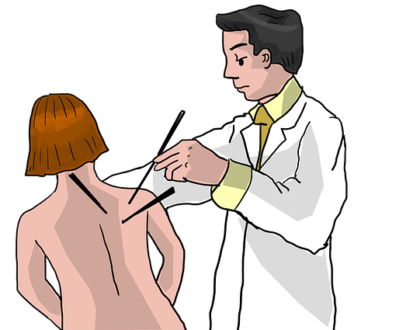
When a muscle is stuck in a deep energy crisis, it often needs an outside catalyst to break the circuit. This is where clinical acupuncture becomes a game-changer [ 4 ].
By inserting a microscopic, sterile needle directly into these ischemic “hot spots” or trigger points, we initiate a profound healing reflex. The micro-stimulus prompts your nervous system to instantly release localized neuropeptides and histamine.
This triggers rapid, powerful vasodilation—literally opening the floodgates to stuck vessels. During a session, you may even notice a temporary warm, red flare around certain needles. This is the visual proof of your body “venting” trapped metabolic waste and rushing oxygenated blood back into the starved tissue. It forces the locked muscle fibers to finally unlatch, resetting your neurological pain loops from the inside out.
The Workspace Fix: Three Rules to Reopen the Vessels
To support your body between treatments and stop creating new “kinks” in your muscles during the day, you can instantly transform your desk setup with three simple, ergonomic rules:
- The Eye-Level Monitor Rule: Your neck should never be tilted down. Elevate your computer screen so that the top third of the monitor sits exactly at eye level. If you work on a laptop, place it on a laptop stand or a stack of sturdy books, and plug in a separate, external keyboard and mouse on your desk [ 5 ].
- The 90-Degree Elbow Rule: If your armrests are too low or your desk is too high, your shoulders have to shrug upward just to hold your arms while you type. Adjust your chair’s armrests so your elbows rest gently at a 90-degree angle. This allows your shoulders to completely drop and relax, taking the physical load off your neck.
The 50-Minute Micro-Break: Your blood vessels can only tolerate a static holding pattern for about 50 minutes before oxygen drops. Set a subtle recurring timer on your phone. Every 50 minutes, take just 60 seconds to roll your shoulders backward and take two slow, resetting breaths. This simple pause forces the constricted capillaries to pop open before pain can accumulate [ 6 ].
Take Control of Your Tissue Health
Persistent neck tension is rarely a sign of permanent structural damage; it is simply a highly responsive nervous system trying its best to cope with a demanding physical setup. By realigning your screen, supporting your arms, and utilizing targeted therapies like acupuncture to clear deep stagnation, you give your muscles the resources they need to finally let go of their grip.
I have helped numerous clients with neck pain of various origin. See if I can help
Recommended Posts
Listening to Your Body: What Chronic Pain is Trying to Tell You and How Acupuncture Solves the Root Problem
September 10, 2026

Beyond Flesh and Bone: Why the Human Body is an Electric Machine
September 7, 2026